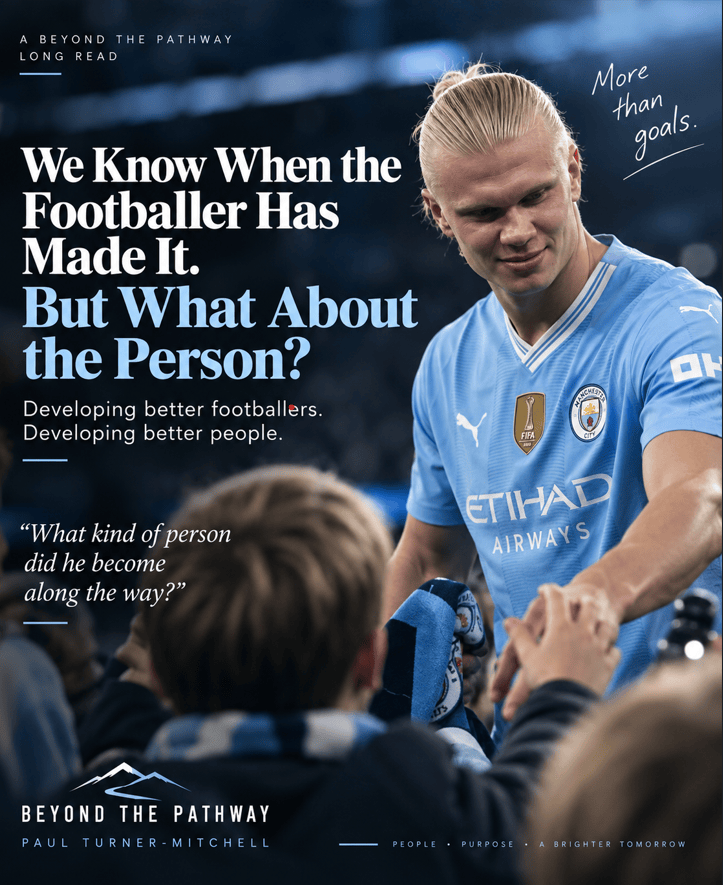
There are things you notice when you spend enough time around elite football that will never appear on a scouting report, performance dashboard or individual development plan.
Through my work at Manchester City, I have been fortunate enough to spend time close to the first-team environment. I have been pitch-side at first-team games overseeing the ball teams, as well as working within the academy environment, and that has allowed me to observe from relatively close quarters things that most people understandably experience only through a television screen.
Over time, I started noticing small things about Erling Haaland. I have watched him remove his warm-up top, fold it and hand it properly to the member of staff rather than simply throw it towards them. I have seen him help put footballs back into the bag after training. From pitch-side, I have watched the way he interacts with mascots and children around the first-team environment.
These are not stories somebody has subsequently told me and they are not observations drawn from social-media clips. They are things I have personally witnessed. None is remarkable in isolation and perhaps that is precisely why I find them interesting. They are ordinary behaviours being demonstrated in an extraordinary environment by somebody who has reached an extraordinary level of status within it. More importantly, they are things he does not have to do.
There was another moment that has stayed with me for a much more personal reason.
A few years ago, I took my son into City with me while I was working. He had broken his shoulder the previous day and had only just started secondary school, so he was still a young lad. His arm was in a sling.
Erling was on the indoor pitch finishing a photoshoot. I was waiting at the side because I needed to set up for an academy session once he had finished. When the shoot ended, he could quite easily have walked away without ever knowing we were there. Instead, he noticed my son, walked across to him and started talking to him.
I don’t know whether Erling remembers that interaction. I suspect he doesn’t. It was probably a tiny moment in a day containing hundreds of interactions and demands on his time. My son and I remember it.
The more I have thought about that moment alongside the other behaviours I have witnessed, the more it has taken me back to one of the fundamental ideas behind my book, Beyond the Pathway. Academy football should not simply develop better footballers. It should aspire to develop better people too.
The difficult question is how we know whether it has.
From Bryne to Manchester
That question made me curious about whether what I had observed at Manchester City was simply that: a collection of unrelated moments. So I started looking backwards through Haaland’s development.
What I found at Bryne, the small Norwegian club where much of his childhood football development took place, interested me enormously. Alf Ingve Berntsen coached Haaland through a significant period of his formative years. There were around 40 children in the group and, unlike the highly professionalised academy structures familiar to us in England, much of their early football was being delivered by volunteer parent coaches.
Accounts from Bryne describe Haaland as a happy child who smiled a lot, trained hard and loved scoring goals. His potential was apparent, although predicting what he would eventually become would have been impossible. He was relatively small and skinny during part of that early development and regularly played with older children.
What interests me more, however, is what Berntsen says about the purpose of their environment. He wanted all the players he coached to do well in life as much as in football, and he and the other coaches consciously tried to instil values that those boys would carry through their lives. When people subsequently asked whether he was proud of his involvement in Haaland’s early football education, his instinctive test was revealing: how had those young people turned out and how did they behave?
There is something wonderfully uncomplicated about that philosophy.
It would be far too simplistic to draw a straight causal line from a childhood football environment in Bryne to an adult folding his training top in Manchester many years later. Human development doesn’t work like that. Haaland will have been shaped by his parents, family, friends, coaches, teammates, clubs, cultures, successes, disappointments and countless experiences that we cannot see.
But the continuity is worth thinking about, because we spend enormous amounts of time identifying the behaviours that might make an eight-year-old become an elite footballer. How much time do we spend intentionally developing the behaviours we would hope that same eight-year-old still demonstrates if, one day, he becomes one of the most famous footballers in the world?
What survives the pathway?
That question sits right at the heart of Beyond the Pathway.
Elite academies have become extraordinarily sophisticated development environments. We identify technical, tactical, physical and psychological characteristics. We assess potential, build individual development plans, analyse performance and measure progression. Increasingly sophisticated data allows us to understand young players in ways that would have been unimaginable a generation ago.
Those things matter. An academy exists, in part, to develop footballers. But if we also claim to develop people, where are the equivalent outcome measures?
We know how to recognise the football outcome. A child progresses through Foundation Phase, becomes a scholar, signs professionally, plays first-team football or represents his country. At the extreme end of the spectrum, he might win major trophies, break goalscoring records and become one of the most recognisable athletes on the planet.
The pathway has very visible markers telling us whether the football development succeeded. If we say that character, humility, respect, responsibility, empathy and belonging matter too, where are the equivalent markers telling us whether that development succeeded?
Perhaps the more interesting question isn’t simply whether the player made it. It is what kind of person made it.
What Guardiola noticed
What makes Haaland an interesting case through which to explore this is that the observations are not mine alone.
Soon after Haaland arrived at Manchester City in 2022, Pep Guardiola was asked what had impressed him about his new striker. Given the goals, physical attributes and competitive mentality Haaland had brought with him, there was plenty Guardiola could have chosen. Instead, he talked about his education and humility.
Guardiola had particularly noticed how much Haaland spoke to the young players around the first-team environment rather than restricting his attention to the established players. He described him as an incredible competitor but said what had impressed him most was his education, his humility and his willingness to engage with those younger players.
That is revealing because young academy players cannot do very much for Erling Haaland’s career. He doesn’t need their approval and they have no organisational power over him. Yet one of the first things his manager noticed was his willingness to engage with them.
Guardiola returned to Haaland’s character as he got to know him better. He spoke about how quickly his personality had impressed him, describing someone who was always smiling and reflecting on the humility he had encountered among some of the biggest stars he had coached. Years later, that assessment remained remarkably consistent. After making Haaland part of City’s leadership group, Guardiola described the unusual combination of a genuinely world-class player who remained incredibly humble, thought about what was best for the team and possessed a kindness alongside his extraordinary competitive drive.
For me, that consistency matters. It doesn’t prove anything definitive about Haaland as a person, and none of us should pretend we can know somebody’s entire character from observations around football. But when behaviours witnessed informally around the environment are consistent with what a manager working with that player every day repeatedly describes, they become worthy of consideration.
Gratitude along the pathway
There are glimpses of the same characteristics earlier in Haaland’s journey.
Paco Johansen worked with him through Norway’s youth international teams. When their period together ended, Haaland took the time to write personally to Johansen and the other coaches to thank them for what they had done for him. Johansen remembers somebody who was appreciative of what he had learned, listened to advice and remained grounded despite already becoming the biggest young star in Norwegian football.
That interests me because gratitude is another developmental behaviour that becomes more difficult to assess as somebody becomes increasingly successful. Every elite player’s journey contains people who helped when there was no guarantee of what the eventual outcome would be. Grassroots coaches, academy staff, teachers, parents, scouts, physios and countless others contribute small pieces to a development journey that may span 15 or 20 years.
Success can make it easy to rewrite that story around the individual. Human development perhaps asks whether the player continues to recognise the people within it.
When Haaland eventually left Borussia Dortmund for Manchester City, there was another example. He reportedly gave farewell watches not only to his teammates but also to dozens of members of the club’s staff. The monetary value inevitably generated headlines. For me, the more interesting point is that the staff were remembered too.
Elite football depends upon enormous numbers of people whose names supporters will rarely know. Medical staff, kit staff, analysts, chefs, security staff, operations teams and countless others create the environment within which the player performs. That brings me back to the warm-up top.
The significance isn’t really whether a piece of clothing is folded or thrown. A kit member’s job will involve dealing with it either way. The interesting thing is the relationship represented by the behaviour. Do I see somebody whose job exists to serve me, or do I see another person contributing to the environment that allows all of us to succeed?
Those are very different ways of understanding status.
Character under autonomy
Academies spend considerable time assessing behaviour. Players are expected to arrive punctually, listen, work hard, demonstrate respect, respond positively to challenge and behave appropriately towards coaches and teammates. Those expectations are entirely reasonable, but there is a problem if we treat compliance with them as the completed product of character development.
A young academy player exists within a hierarchy in which adults hold most of the power. Coaches select him. Staff assess him. Clubs decide whether he remains within the programme. Adults establish the standards and consequences. A young player may therefore behave appropriately partly because the environment requires him to.
Elite success eventually reverses much of that hierarchy.
Imagine the distance between the child at Bryne and the adult Erling Haaland. The child is learning how he is expected to behave within a football environment. The adult has wealth, fame, enormous professional status and millions of followers. Thousands of people want something from him. Entire commercial campaigns are built around him and members of staff exist specifically to support his performance.
Nobody is going to remove one of the world’s greatest strikers from the team because he didn’t help put the footballs away. That is why I think status provides such an interesting test of development.
Character under instruction is not quite the same thing as character under autonomy.
Perhaps one of the ultimate tests of development is what somebody chooses to do when nobody needs to tell them anymore.
Learning to notice
Thinking again about the moment involving my son, there is another quality underneath kindness or respect that I think we sometimes overlook. Before you can demonstrate either, you first have to notice another person.
Erling didn’t have to notice a young boy standing quietly at the side of an indoor pitch with his arm in a sling. He had finished what he was there to do. My son wasn’t waiting for an autograph or being presented to him as part of an organised engagement. He simply noticed him and then acted upon what he noticed.
The same principle arguably sits underneath many apparently mundane interactions. To acknowledge the kit person, you first have to recognise them as more than a function. To engage properly with a mascot, you have to appreciate that the few seconds you spend with that child may carry considerably more meaning for them than they do for you. To engage with young academy players when you are an established superstar requires some awareness of what your attention might mean to them.
Perhaps an important human-development outcome is therefore remarkably simple: do you continue to notice other people?
What happens when it hurts?
There is another dimension to this that became visible during the 2026 World Cup.
Norway’s tournament had been extraordinary. Haaland scored seven times in his first four appearances as his country reached the quarter-finals, where they faced England in Miami. It ended in disappointment, with England winning 2–1 after extra time. Haaland had been kept off the scoresheet for the first time in the tournament and the conditions had taken an enormous physical toll. The heat and humidity were oppressive, he had suffered a dead leg and eventually had nothing left. Norway coach Ståle Solbakken subsequently explained that Haaland was physically finished and substituted him during extra time.
For somebody as relentlessly competitive as Haaland, the disappointment must have been enormous. Norway’s best World Cup run was over, but what happened around that defeat interests me.
After the final whistle, Haaland remained on the pitch for several minutes to acknowledge the Norwegian supporters. It was subsequently reported that he was the final Norway player to leave the stadium, staying behind until around 9.30pm while meeting supporters and families and taking photographs.
Again, it is a relatively small thing, but perhaps human development is also revealed by what we do when things haven’t gone our way. It is relatively easy to acknowledge supporters while carrying a trophy. It is harder after your World Cup has just ended, your body is exhausted and all you probably want is some privacy in which to process the disappointment.
There is also something here that connects very personally with my own experience of Haaland. A photograph or conversation with another child may occupy only a few seconds of an elite player’s life. For the child receiving that attention, those few seconds can become a lifelong memory.
I know that because I have seen it happen. My son cannot tell you what else Erling Haaland did on the day he met him. Erling probably cannot remember the interaction at all. But my son remembers that Erling noticed him. Perhaps some of those families in Miami now have their own version of that story.
That matters because developing the person cannot simply mean teaching appropriate behaviour when circumstances are comfortable. Football inevitably brings disappointment, rejection, injury, frustration and failure. One measure of development must therefore be how somebody responds when those emotions are at their strongest.
How do I treat other people when I am disappointed? Can I recognise what a moment means to somebody else even when the moment is painful for me? Can I still give something of myself when personally I would rather withdraw? Those aren’t football questions. They are human ones.
Human Development Indicators
In Beyond the Pathway, I explored the idea of Human Development Indicators because I believe we need a broader conception of what successful development means.
I am not suggesting academies should create a spreadsheet awarding somebody 8.7 for kindness or add another coloured box to the multidisciplinary review. Human beings are too complicated for that, and attempts to quantify character can very quickly become another selection tool masquerading as development.
But that doesn’t mean human development cannot be considered, observed and evaluated.
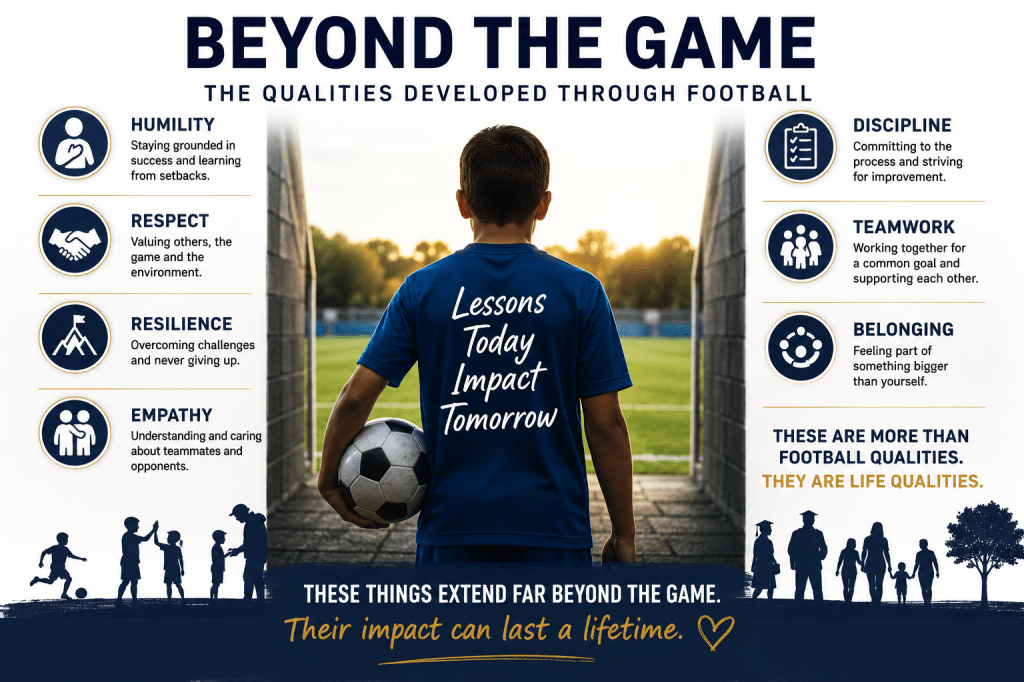
We can ask whether a player recognises the contribution of others and how they treat people with less organisational status. We can consider whether they contribute when there is nothing obvious to gain, whether they demonstrate gratitude, how they respond to another person’s vulnerability and whether they can genuinely celebrate somebody else’s success. We can observe how they accept responsibility, how they remain connected to people and communities that contributed to their development and, eventually, how they use status when they acquire it.
Perhaps one of the most revealing questions is what somebody does when nobody is assessing them.
The purpose of those questions, however, should not be to decide whether a child possesses the “right character”. That would simply turn human development into another Talent ID filter. The accountability should sit with us.
Instead of asking only, does this child demonstrate the characteristics we want?, we should also ask, what is our environment doing to help this child develop those characteristics?
That is stewardship.
The football outcome and the human outcome
There is an obvious danger in using Haaland as the example because he represents an almost impossibly successful football outcome. Most children entering academies will not become Premier League footballers. Some will play professionally elsewhere, some semi-professionally and many will leave the professional pathway altogether. They will become teachers, electricians, business owners, coaches, parents and volunteers at grassroots football clubs.
That doesn’t weaken the argument. It strengthens it.
If an academy genuinely believes that developing the person forms part of its responsibility, human development cannot be something whose value depends upon eventually producing a professional footballer. The football outcomes will vary enormously, but the human outcome applies to everybody.
A player who leaves an academy at 16 having developed confidence, responsibility, empathy, independence, meaningful relationships and a secure sense of his own worth has not left empty-handed simply because professional football did not follow. Those things travel with him. The pathway may end, but the person continues.
That is one of the reasons I use the language of stewardship in Beyond the Pathway. For however long a child remains within an academy, the club becomes one of that child’s developmental environments. Coaches and staff become influential adults. Teammates become friendship groups. Football influences routines, identity, confidence, relationships and experiences.
That creates a responsibility extending beyond improving somebody’s first touch. If we accept stewardship, success cannot simply be measured by how much football talent emerges at the other end. We also have to care about what happens to the person travelling through it.
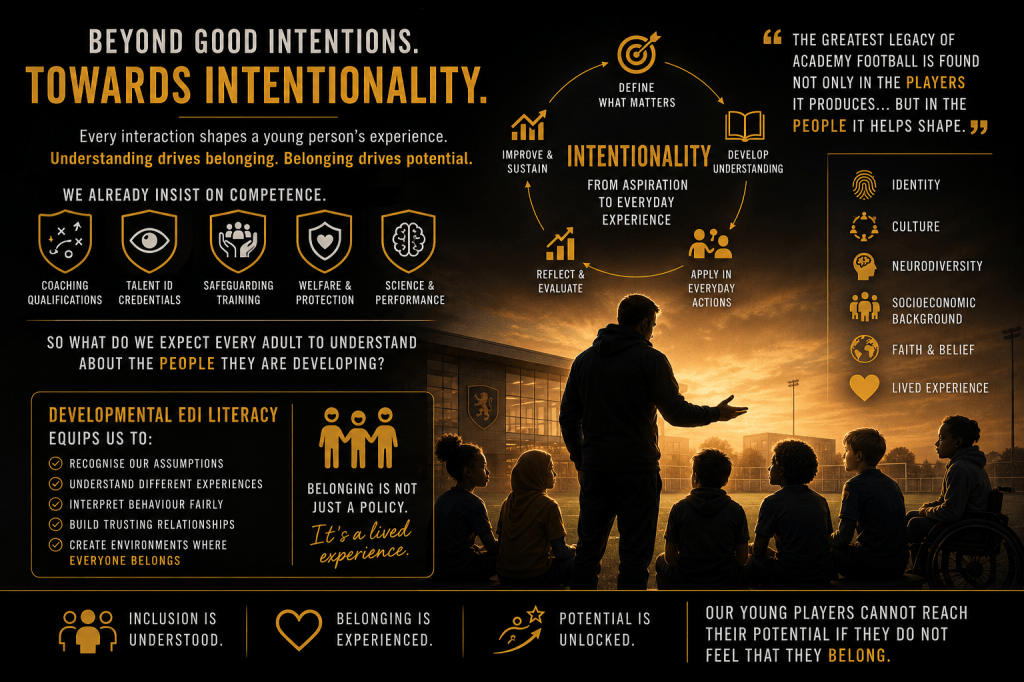
And that requires intentionality. We would never simply hope that a child accidentally develops technically. We coach it, create environments for it, revisit it, model it, reflect upon it and invest enormous expertise in it. Why should human development deserve less intentionality?
The outcome at the other end
That brings me back to Haaland.
At Bryne, one of the adults involved in his formative football years has spoken explicitly about wanting the children he coached to do well in life as much as football and about the importance of the values they carried with them. Later, one of Haaland’s Norway youth coaches remembered a young player who took the time to write and thank the people who had helped him.
At Manchester City, Guardiola encountered the established elite footballer and almost immediately found himself talking publicly about Haaland’s humility, his education and the way he treated young players. Years later, Guardiola was still talking about his humility and kindness.
Between those points sits one of the most extraordinary football development stories of his generation: Bryne, Molde, Salzburg, Borussia Dortmund, Manchester City, international football, records, trophies and global celebrity.
I cannot tell you which parts of that journey produced the behaviours I have witnessed, nor can I claim that those behaviours provide a complete picture of the man. But I find the continuity fascinating.
A child entered a football environment in Bryne in which the adults around him believed that the person mattered alongside the footballer. Many years later, I have watched the global superstar that child became fold his warm-up top before handing it to a member of staff, help put footballs away and make time for children around the first-team environment. I have watched Guardiola notice similar things, and I have read the recollections of people who worked with Haaland earlier in his development who describe gratitude and humility.
Then, at a World Cup, with his body exhausted and his country’s tournament having just ended, he acknowledged supporters and was reportedly the last Norway player to leave the stadium after spending time with families and fans.
On one occasion, I experienced the impact of one of those small interactions personally. My son was just another young lad standing at the side of an indoor pitch with his arm in a sling. Erling Haaland noticed him and, years later, we still remember that he did.
Perhaps that is where the measurement question becomes most difficult and most important.
Academies are becoming increasingly good at determining whether their football development worked. We can count appearances, professional contracts, international caps, transfer values and first-team graduates. Those are legitimate measures of an elite football development programme.
But if we say that we also develop better people, we should have the courage to ask what evidence of that development looks like once those children become adults. Not only when they succeed, either. We should care just as much about the person who leaves at 12, 16 or 18 as the one who eventually walks into the first-team dressing room.
The player who reaches the very top does, however, give us a particularly interesting test. What remains when the status changes? Does respect remain when deference is no longer required? Does gratitude survive when almost everything is provided for you? Do you recognise the contribution of people whose names will never appear alongside yours? Do you help when somebody else is employed to do the job? Do you notice the child for whom ten seconds of your time might become a lifelong memory? And when football delivers its inevitable disappointments, do those behaviours survive then too?
We spend enormous amounts of time identifying the behaviours that might make an eight-year-old become an elite footballer. We should spend just as much time thinking intentionally about the behaviours we would hope that same eight-year-old still demonstrates if, one day, he becomes one of the most famous footballers in the world.
Because perhaps the question at the end of a development pathway should never simply be whether we developed the player we hoped that child might become. There is another outcome that matters just as much:
What kind of person did he become along the way?
That, ultimately, is part of what Beyond the Pathway means to me. Developing better footballers and developing better people should never have been competing ambitions.
The very best development environments should aspire to do both.


 Site Title